
You look at your phone. He still hasn’t replied. It’s been an hour. Then two.
Your mind races.
Your mood changes. So does your day.
If this situation sounds familiar, you are not alone. Many people confuse intense love with emotional dependence. In movies, songs, and TV series, passionate love is often portrayed as something all-consuming, exclusive, almost obsessive. We are taught that suffering for someone is proof of love.
But is that really the case?
Feeling strong emotions does not necessarily mean experiencing healthy love. Sometimes what we mistake for passion is actually a fear of abandonment, a lack of inner security, or difficulty being alone.
In this article, we will clarify the differences between love and emotional dependency.
- what balanced love really is,
- warning signs,
- why we can fall into a toxic relationship without realizing it,
- and how to rebuild a healthy romantic relationship, starting with yourself.
The goal is simple: to help you protect your emotional well-being and make more conscious relationship choices.
What is Healthy Love?
Healthy love is not fusion. It is interdependence.
This means that two people choose to be together, not because they cannot live without each other, but because they feel better together.
1. It is a choice, not a vital necessity.
In a balanced romantic relationship, your partner is not an emotional lifeline. He or she is a partner.
You may feel a sense of longing, of course. That’s normal. But that loss does not destroy you. It does not call your personal worth into question.
Love adds to your life. It does not replace it.
2. Everyone keeps their identity
In healthy love:
- you keep your friends,
- you continue pursuing your passions,
- you pursue your personal projects,
- you have your own space.
You don’t have to do everything together to feel secure.
3. The relationship provides energy and security.
A balanced love gives a feeling of stability.
You don’t live in constant fear of losing the other person.
You feel respected, listened to, and secure. This type of relationship is based on trust, communication, and independence. This is what we call a balanced romantic relationship.
See also: Love compatibility test: astrological signs & first names
Signs of a balanced love
Recognizing healthy love is not based solely on how you feel, but on what you experience on a daily basis. A balanced romantic relationship is characterized by simple but powerful signs.
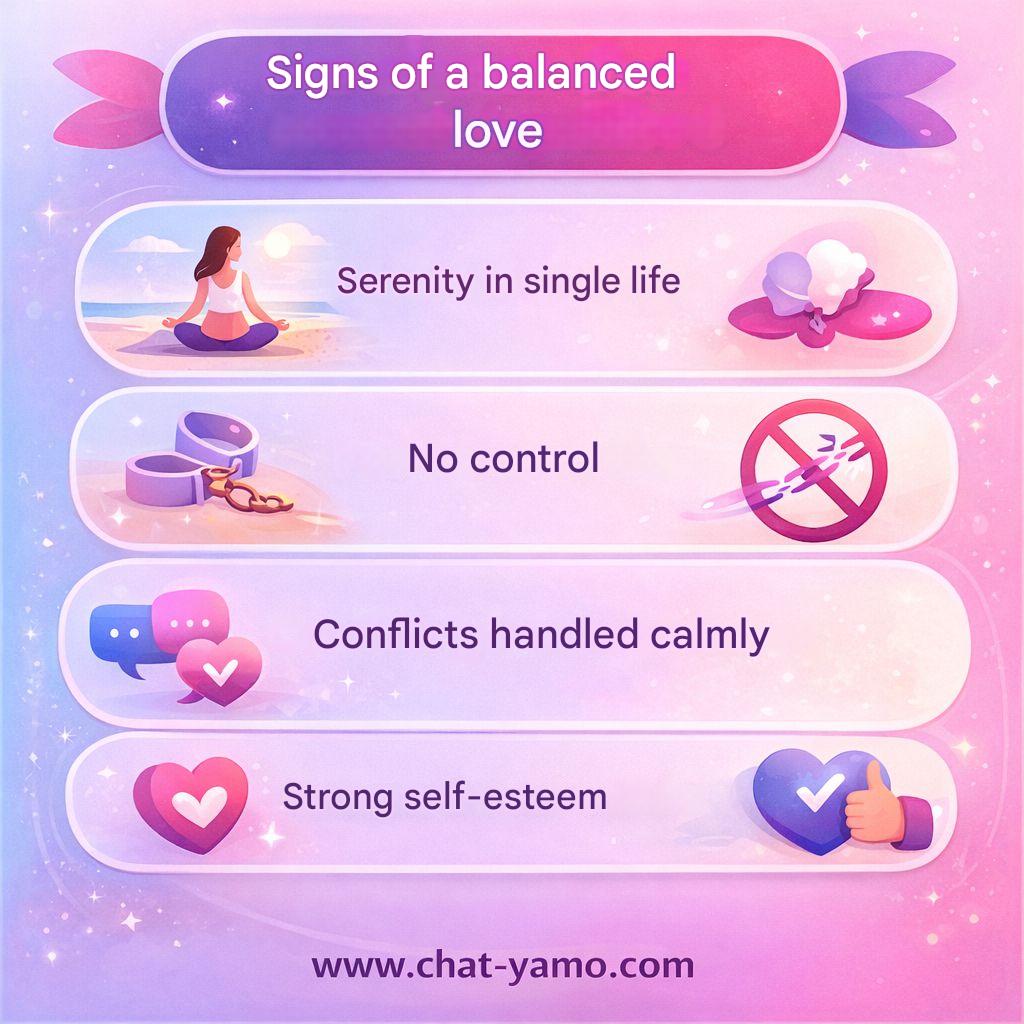
Here are the most reliable benchmarks.
1. You can be alone without feeling anxious.
In a balanced relationship, the absence of the other person does not trigger panic.
You can spend an evening alone, go away for the weekend with friends, or go a few hours without hearing from someone without imagining the worst. Silence does not become a threat.
This does not mean that you do not care about the other person. It means that your emotional security does not depend entirely on their presence.
Loneliness is not experienced as abandonment.
2. You do not seek to control
Healthy love leaves space.
You don’t need to monitor, check, test, or manipulate to reassure yourself. You don’t search through their phone. You don’t provoke jealousy to gauge their attachment.
Control is often a sign of disguised emotional dependence.
3. Disagreements do not threaten the relationship.
In a balanced relationship, conflict does not necessarily mean breakup.
You can disagree without fearing that everything will fall apart. Discussions are for understanding, not for dominating.
There is no emotional blackmail such as:
“If you really loved me, you would do this.”
Disagreements are normal. What matters is how they are handled.
4. Self-esteem does not depend on your partner’s opinion of you.
In a healthy relationship, you feel loved, but your self-worth does not depend solely on that person’s opinion of you.
You are not defined solely as “someone’s person.” You have your own identity, your own qualities, your own self-esteem.
If your partner is in a bad mood, it doesn’t destroy your self-confidence.
When these elements are present, we talk about interdependence. But when anxiety, control, and fear dominate, we are closer to emotional dependence. And that is where the difference becomes crucial.
See also : Love Beyond Borders: Finding Your Soulmate Within the African Diaspora
What is emotional dependency?
Emotional dependency is not simply a matter of loving deeply. It is an excessive need for the other person in order to feel alive.
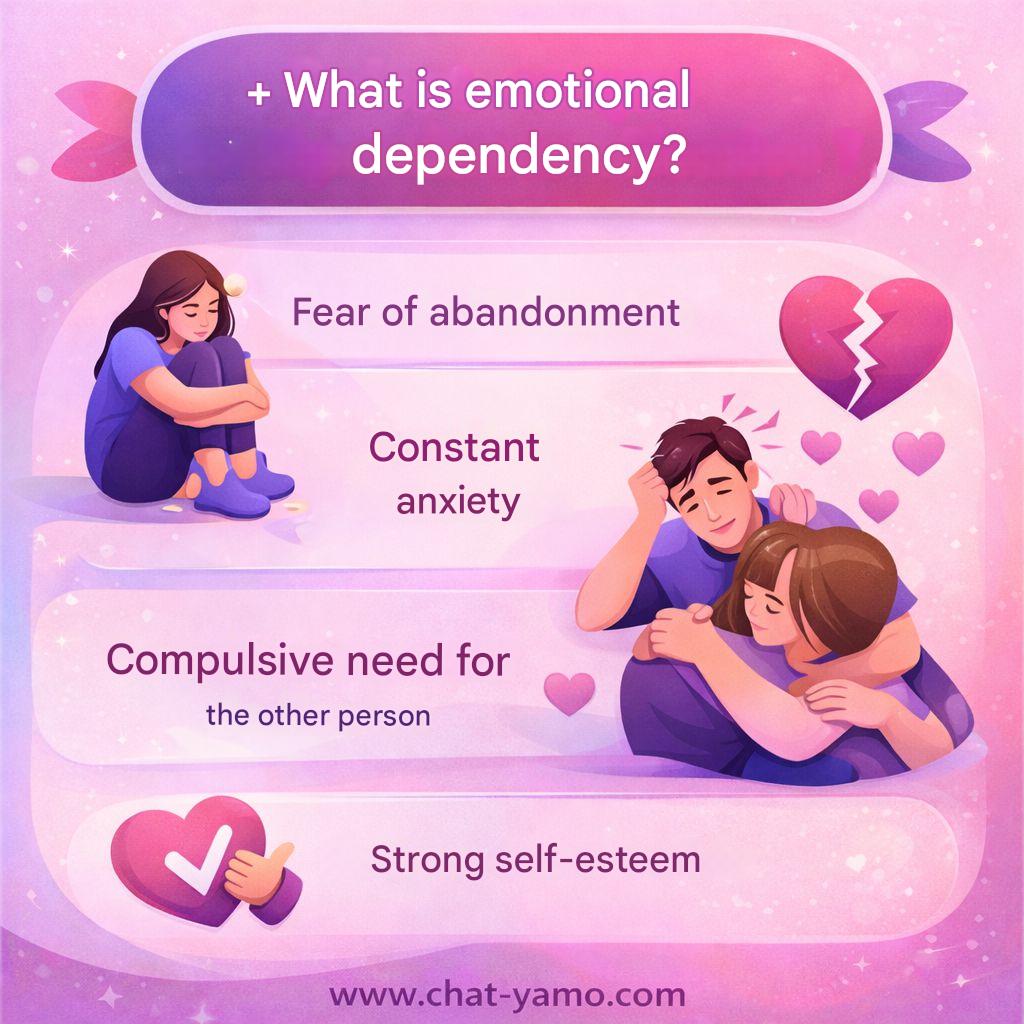
Where healthy love is based on choice, dependence is based on fear.
1. A compulsive need for the other person in order to feel alive
In a situation of emotional dependency, the relationship becomes central. Too central.
The other person is no longer a partner, but a source of validation.
Without him or her, a void appears. A feeling of incompleteness, sometimes even uselessness.
We no longer seek to share our lives with someone.
2. A panic fear of abandonment
The fear of losing the other person becomes disproportionate.
An unanswered message can trigger a surge of anxiety.
This fear sometimes leads people to accept the unacceptable:
We would rather suffer in a relationship than risk being alone.
3. A relationship that causes anxiety and constant doubt
Instead of providing security, the relationship becomes an emotional roller coaster.
There are intense highs, followed by painful lows.
Energy is consumed by doubt:
Unlike a balanced love, emotional dependency drains you more than it nourishes you. The good news is that recognizing these mechanisms is already a first step. And that step requires courage.
See also : Dating after 30, 40, 50: what really changes
Emotional dependency: warning signs to look out for
The goal here is not to judge you.
Emotional dependency can develop gradually. We don’t always realize it at the time. Here are the most common signs.
Sign 1: Your mood depends entirely on the other person’s actions.
If he or she is attentive, you feel on top of the world. If he or she is distant, you feel rejected, anxious, sometimes even devalued.
Your emotional stability depends almost entirely on his behavior. A simple message can brighten your day. A lack of response can ruin it.
Sign 2: You neglect yourself in favor of your relationship
Little by little, you put aside:
- your friends,
- your activities,
- your personal projects,
- sometimes even your career.
All your energy is focused on the relationship.
In a balanced romantic relationship, the couple enriches life.
Sign 3: You justify toxic behavior
You make excuses for what causes you pain:
“He acts like that because he’s afraid of losing me.”
You minimize disrespectful behavior. You rationalize hurtful behavior.
Over time, this can lead you into a toxic relationship without you really realizing it.
Sign 4: Inability to be alone
The very idea of loneliness makes you anxious.
You jump from one relationship to another.
It’s not love that’s holding you back.
Sign 5: The cycle of breakups and dramatic reconciliations
The relationship is intense, unstable, sometimes explosive.
You part ways.You meet again.
Then the same problems reappear.
This cycle creates a form of emotional addiction. We confuse intensity with deep love, when in fact it is often an insecure attachment.
An important note
Emotional dependency can be treated.
By working on self-esteem and, if necessary, seeking therapeutic support.
Recognizing these signs does not make you weak.
And understanding where this dependency comes from is often the key to breaking the cycle.
Why do we fall into emotional dependency?
Emotional dependency does not come out of nowhere.
It often has deep roots.
Understanding these causes is not about finding someone to blame. It allows you to regain control over your love life.
1. Lack of self-esteem
When self-esteem is fragile, we unconsciously seek someone to reinforce it.
The gaze of the other becomes proof of worth.
If this validation disappears, everything falters.
In this context, the relationship is no longer based on balanced sharing, but on a constant need for recognition. We cling to the other person to feel “enough.”
2. Past injuries
Some experiences leave a lasting impression:
- childhood abandonment,
- betrayal in a previous relationship,
- repeated rejection,
- lack of emotional attention.
These wounds can create a deep fear of being abandoned or replaced. The person then becomes hypervigilant, anxious, and sometimes overly dependent. This is not a character flaw. It is a maladjusted defense mechanism.
3. Unstable relational models
We learn to love by observing.
If you grew up in an environment where love was conditional, conflictual, or unpredictable, you may unconsciously repeat these patterns.
We confuse tension with passion. We associate instability with intensity.
This pattern can lead to toxic relationships or insecure attachments.
4. Difficulty being alone
Some people cannot stand emotional emptiness.
Being alone means facing your doubts, your fears, your inner silence. So you seek company at any cost.
In this case, the relationship becomes a refuge from loneliness rather than a conscious choice.
However, healthy love is not about escaping from oneself. It is based on the ability to live life to the fullest, with or without a partner.
At this point, a question arises: If we notice signs of emotional dependency, how can we build a healthier relationship? The answer often begins with personal work.
Rebuild your self-esteem before rebuilding your relationship
You can’t build a balanced romantic relationship on a fragile foundation.
If emotional dependency is linked to low self-esteem, then the priority is not to find someone else. It is to find yourself.
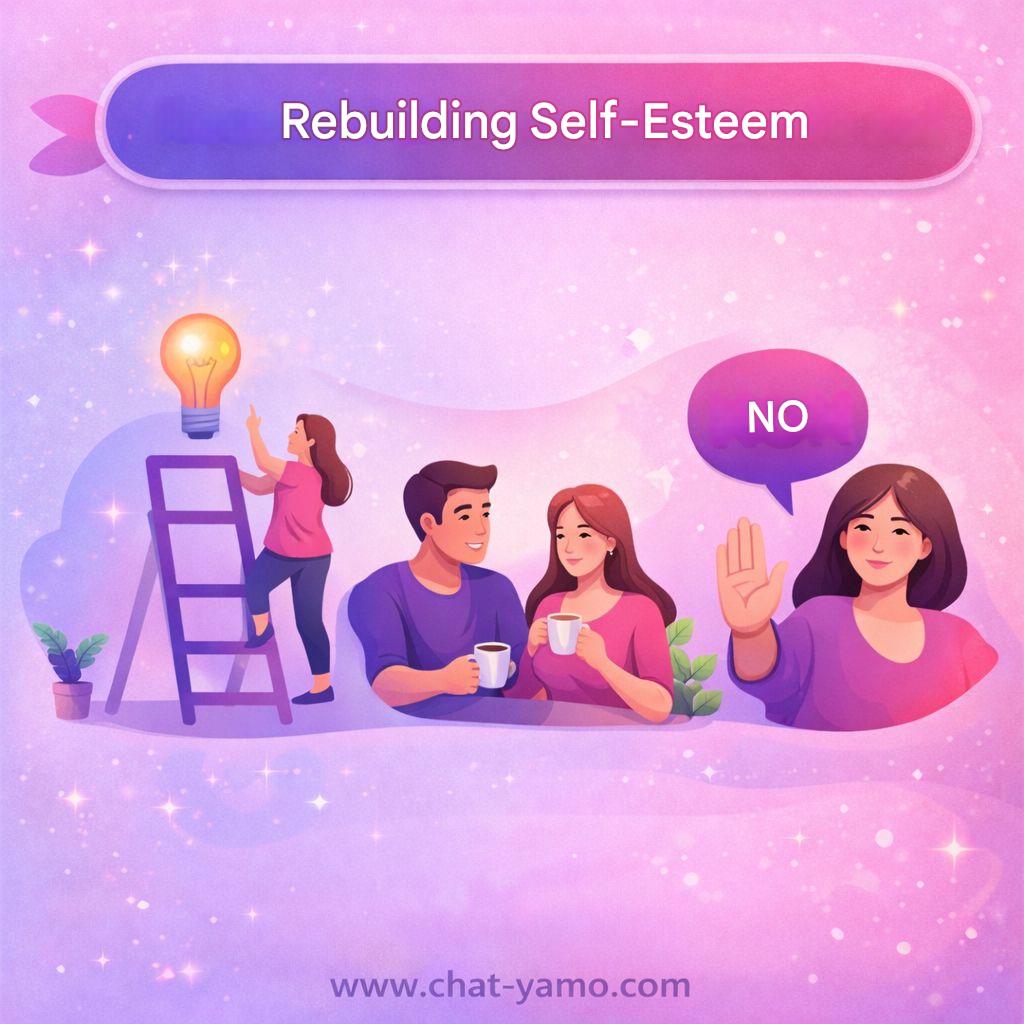
This does not mean isolating yourself from the world. It means becoming the center of your own life again.
1. Develop your personal projects
A personal project provides direction.
This could be:
- training,
- a professional goal,
- a creative project,
- a sporting activity,
- a commitment to community service.
The important thing is not the size of the project.
When you move toward something that motivates you, your identity no longer depends solely on your partner. You exist outside of the relationship.
And the more fulfilled you feel, the less you need the other person to “complete” you.
2. Maintain friendships
Emotional dependency isolates.
Healthy love coexists with other bonds.
Friends offer:
- hindsight,
- support,
- different perspectives,
- a space where you are not defined solely as a partner.
Maintaining these relationships strengthens your emotional stability. You no longer place all your emotional security in one person.
3. Learning to say no
This is often the most difficult part.
Saying no means accepting the risk of displeasing others.
In a dynamic of emotional dependency, we often say yes out of fear of losing the other person. We accept things that hurt us. We minimize what bothers us.
Learning to set boundaries means respecting yourself.
Paradoxically, this creates stronger relationships, because healthy relationships are built on clarity rather than fear. Rebuilding self-esteem does not happen overnight. But every little action counts.
And when you start to feel stable on your own, you naturally become more demanding about the quality of your relationships. That’s when the choice of partner and the context in which you meet them becomes so important.
See also : How to gain confidence before a date? | Chat&Yamo
Chat&Yamo, a healthy space designed for meaningful encounters
Once you understand the mechanisms of emotional dependency and begin to rebuild your self-esteem, an important step comes: meeting someone new.
But the context of the meeting plays a key role.
Not all apps promote healthy romantic relationships. Some encourage compulsive swiping, constant comparison, and the search for instant validation. This can increase insecurity and reinforce patterns of dependency.
This is precisely where Chat&Yamo stands out.
1. An app designed for real relationships
Chat&Yamo is not designed to multiply short-lived matches.
The goal is not quantity.
The app emphasizes real connections, complete profiles, and clear intentions. We move away from impulsive reflexes and toward a more conscious approach.
When you’re looking for healthy love, this setting changes everything.
2. Features that support emotional well-being
2.1. Verified profiles
Verifying profiles reduces anxiety related to fake accounts and ambiguous behavior. Less uncertainty means greater emotional security.
When you come out of an unstable or toxic relationship, this feeling of reliability is essential.
2.2. An affinity matching system
The matching system prioritizes common values and shared interests.
This avoids building a relationship solely on attraction or emotional neediness. The foundations are more solid. Compatibility goes beyond appearances.
2.3. Tools to break the ice and facilitate conversation
Even before meeting in person, the app encourages deeper exchanges.
Take the time to talk, to understand the other person’s vision, expectations, and pace. This helps avoid rushing things and establishes a healthier framework from the outset.
2.4. Security as a foundation
For someone who has experienced emotional dependency, feeling secure is essential.
A clear, structured, respectful environment limits manipulation and emotional ambiguity.
Chat&Yamo offers a safe space where everyone can progress at their own pace, without pressure or constant competition.
Meeting someone should not be about filling a void.
It should be a meeting between two people who are already complete.
Download Chat&Yamo not to fill a void, but to share your fulfillment with someone who is right for you.
See also: Getting started with a dating app: a simple guide to help you take the plunge
Conclusion
Love elevates, while emotional dependency alienates.
The difference isn’t in the intensity of the emotions, but in the freedom you feel. In a healthy love, there is trust, space, and respect. You can breathe. You can be yourself.
In emotional dependency, fear dominates. The relationship becomes a vital need. Anxiety takes precedence over serenity.
The good news is that it is possible to move from one to the other.
With time. With work on self-esteem.
Every realization is a step toward a balanced romantic relationship. Even if the road seems long, it always starts with a simple decision: to take care of yourself.
Today, you can choose:
- to set a limit,
- to reconnect with a friend,
- to restart a personal project,
- or simply observe your patterns with kindness.
And when you’re ready to meet someone, do so in a setting that respects your progress.
Chat&Yamo was designed for those who want to build conscious relationships based on compatibility and emotional security.
Ready to experience healthy love? Start here!
FAQ – Frequently asked questions about love and emotional dependency
How can I tell if I am emotionally dependent?
If your mood depends entirely on messages, reactions, or the presence of the other person, that’s a sign. Anxiety when apart, constant fear of losing the relationship, or neglecting your own needs are also telltale signs. Working on yourself and choosing a safe dating environment helps break this pattern early on.
Can emotional dependency disappear?
Yes. With work on self-esteem, sometimes therapeutic support, and more conscious relationship choices, patterns change. The most important thing is to understand your triggers. Then, focusing on encounters based on shared values and meaningful exchanges helps to avoid recreating an unbalanced dynamic.
What is the difference between passionate love and a toxic relationship?
Passion can be intense without being destructive. A toxic relationship, on the other hand, is exhausting, makes you feel insecure, and creates a cycle of repeated conflicts. If you feel more anxiety than peace, you need to ask yourself some questions. Focusing on authentic, progressive connections greatly reduces the risk of falling into unstable relationships.
Can you love someone and be emotionally dependent at the same time?
Yes, it is possible. Feelings can be sincere, but mixed with a deep fear of abandonment. This mixture creates confusion and suffering. The goal is not to stop loving, but to learn to love without losing yourself. A more structured dating environment helps lay healthier foundations from the outset.
How can you build a balanced romantic relationship?
Start by strengthening your independence: personal projects, friendships, clear boundaries. Then, choose partners who are emotionally compatible, not just attractive. We make all of this easier for you on Chat&Yamo by providing you with verified profiles and a matching system based on real affinities.
Do dating apps promote emotional dependency?
Some may encourage constant comparison and quick validation, which fuels insecurity. It all depends on how the platform works. At Chat&Yamo, we prioritize the quality of exchanges, profile verification, and compatibility of values, which provides a more reassuring environment for developing healthy and lasting love.